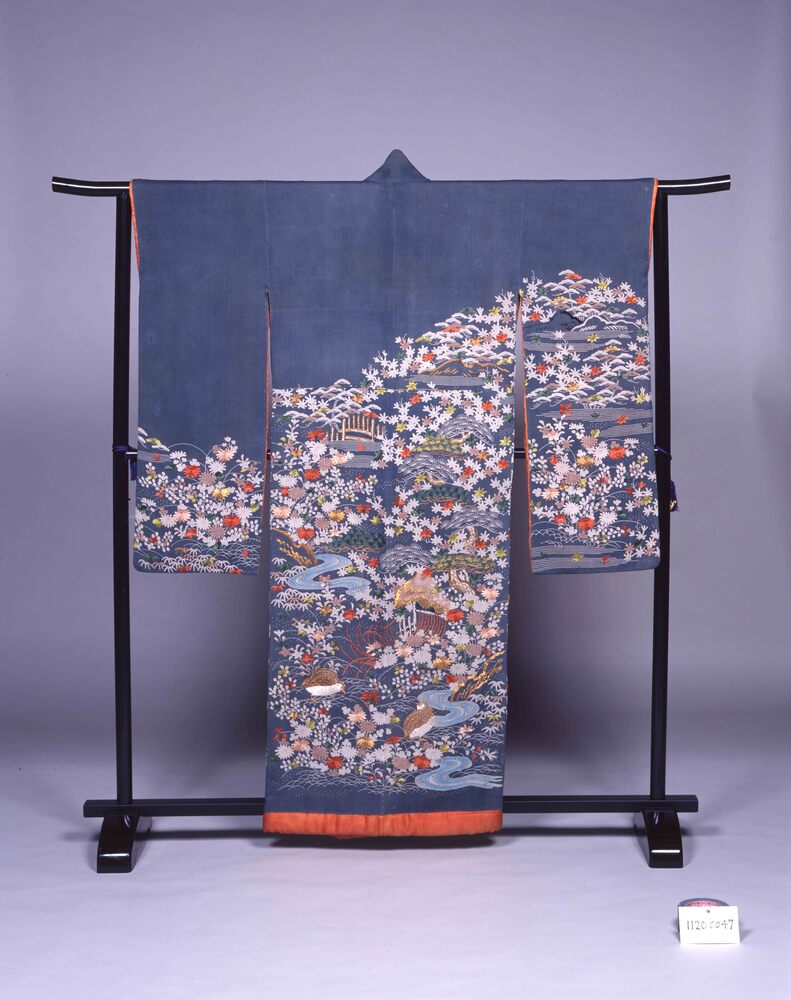
This furisode, a deep-sleeved garment, was worn by a woman of the warrior class. The fabric is gray crepe with a tinge of blue, to which a rich array of autumnal motifs have been added, mainly by embroidery, using colored yarns and gold threads.
The white areas were created using the shiroage technique in which, before dyeing, a bosen nori, a paste resist, is applied to the areas to be left undyed. That technique has been used here to create a variety of motifs.
The motifs arranged on this furisode include maple leaves, chrysanthemums, bush clover, Chinese bellflower, and other botanical motifs, plus flowing water, bamboo shades, quail, and other designs. Water flowing from chrysanthemum leaves signifies the miraculous water that brings long life and perpetual youth.
A distinctive motif is the quail arranged near the hem of the garment. Daimyo and samurai households raised quail, whose voice, ringing out clearly in autumn in the early morning, was regarded as beautiful. The quail has become a seasonal word evoking autumn in haiku poetry. Raised and admired as early as the Muromachi period (1336-1573), quail attracted enthusiasts not only in samurai families but also among ordinary townsmen in the Edo period (1603-1867). They became so popular that a Book of Quail, explaining how to raise them, how to identify the better birds, and what cries were good or bad, was published in Edo in 1649.
No detailed information about the samurai-class woman who owned this furisode are available, but it is fun to imagine that she may have been a quail fan, isn’t it?
- Collection of
- Edo-Tokyo Museum
- Title
- Gray Crepe, Long-sleeved Kimono designed with Autumn Landscape of Quail
- Collection ID
- 11200047
- Category
- Craft
- Sub Category
- Textile Arts
- Creation Date
- 19世紀
- Size
- 157.7cm x 63.8cm x 97cm
- Edo-Tokyo Museum Digital Archives
- https://www.edohakuarchives.jp/detail-500.html