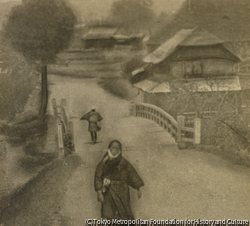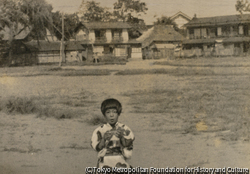
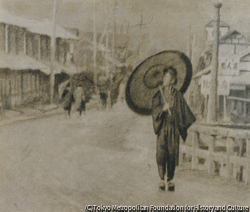
This work is a classic example of rag-wipe retouching (zokin-gake), which is a combination of several techniques. Those include removing the hood from the camera to shoot the image (fuudo-hazushi), then, in making the print, combining deformation to make the central figure appear longer and thinner, use of oil to blur unwanted parts of the image, and finally, retouching or overdrawing (kakiokoshi) with pencil to add emphasis to parts of the image, such as, in this case, an umbrella or kimono.
KOSEKI Shotaro was born in the city of Fukushima and was active as an amateur photographer in that area throughout his life. He published his work and articles explaining photographic techniques in Geijutsu Shashin Kenkyu (Art Photography Studies) and Photo Times. While KOSEKI made the most of soft-focus techniques resulting from the usage of the Vest Pocket Kodak (Besu-Tan) camera, deformation, and rag-wipe retouching, his work also communicates the sense of naive simplicity rooted in the cultural climate of his native region that can be seen in the work of the painter SEKINE Shoji, a fellow native of Fukushima.
- Collection of
- Tokyo Photographic Art Museum
- Title
- Rain in the northern country
- Original title
- 北国の雨
- Artist Name
- KOSEKI Shotaro
- Year
- 1927
- Material / Technique
- Gelatin silver print on developing-out paper
- Dimensions
- 215x257mm
- Accession number
- 10004012
- Tokyo Photographic Art Museum “Search the Collection”
- https://collection.topmuseum.jp/Publish/detailPage/12196/