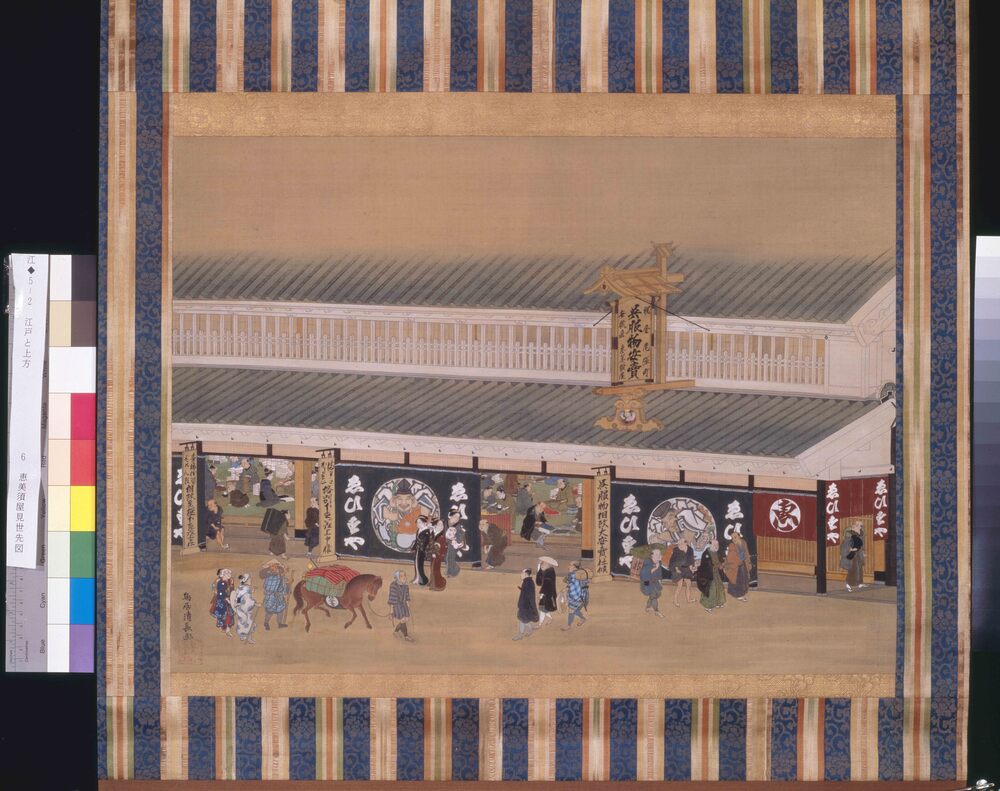
The subject of this work, which depicts an amazingly imposing store, is the Ebisuya, a dry-goods dealer in what is now the Ginza district of Tokyo. The Ebisuya ranked with the Mitsui Echigoya (ancestor of today’s Mitsukoshi department stores) as a dealer in dry goods, i.e., fabrics for kimonos.
Large noren curtains with the name of the store hang at its front. Filling the huge circles is the smiling Ebisu, one of the gods of good luck, with a sea bream (which also symbolizes good luck). The sign on the roof of the store says, “Dry goods at low prices.” Little, it seems, has changed in the devices that stores use to attract customers’ attention.
Look closely, and you will realize that the interior of the store is also depicted in detail: People looking at items, a clerk preparing tea for a customer, a shopper leaving the store, his purchase wrapped in a furoshiki cloth, a clerk greeting a customer with a deep bow. It is fascinating to recognize that we are seeing cash sales, a practice that was spreading at the time.
Edo-period ukiyo-e, whether brush-drawn paintings or prints, include many that depict major stores. These are valuable historical documents for learning about life in the Edo period. But, we wonder, was this ukiyo-e commissioned for the satisfaction of the owners and operators of the store or for advertising purposes?
- Collection of
- Edo-Tokyo Museum
- Title
- In Front of the Ebisuya Theater
- Collection ID
- 87201319
- Category
- Painting&Print
- Sub Category
- Japanese Painting
- Creator
- TORII Kiyonaga
- Creation Date
- 1789 18世紀
- Size
- 45.8cm x 61.8cm
- Edo-Tokyo Museum Digital Archives
- https://www.edohakuarchives.jp/detail-2682.html