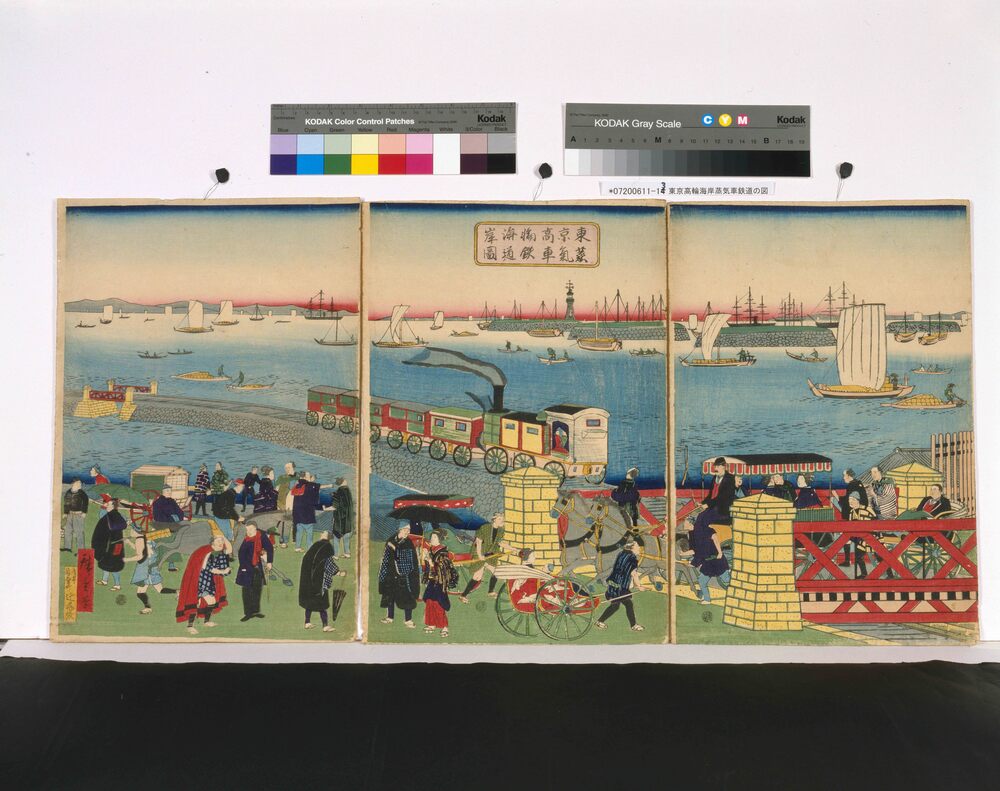
In 1871, Shimbashi Station was built in what is now Shiodome, Tokyo. The following year, the railway line connecting it with Yokohama, whose port was open to international trade, went into operation. This polychrome print shows a steam engine passing by Takanawa on that line. What is particularly notable here is the long, narrow embankment along which the rails have been laid.
The route between Shimbashi and Yokohama was about 29 kilometers long. Opposition by the Military Ministry and others made it impossible to secure land for its construction in the section along the Takanawa shore, from Honshiba to Shinagawa, in Tokyo. Instead, an embankment was built offshore and the rails laid there. The embankment was 2.7 kilometers long and 6.4 meters wide. The earth to build it was provided by leveling Gotenyama and Yatsuyama, two hills near what is now Kita Shinagawa.
This print shows that the side of the embankment are walls of stone. Originally part of Shinagawa Daiba, a battery built in the closing years of the Tokugawa shogunate to help defend Edo, the stone walls were repurposed in building the railway. Since this print was created the year before the railway opened, this embankment built out in the bay was, from the very start, regarded as an archetypical railway scene.
The train shown here, traveling along the rails laid on the route over the water, would soon reach Shimbashi Station. The site of the original station was discovered at the Shiodome site, where archaeological studies were carried out as part of the redevelopment of the former Japanese National Railways Shiodome freight terminal.
- Collection of
- Edo-Tokyo Museum
- Title
- Steam Locomotive along the Takanawa Coast in Tokyo
- Collection ID
- 07200611-07200613
- Sub Category
- Block prints
- Creation Date
- 1871 19世紀
- Edo-Tokyo Museum Digital Archives
- https://www.edohakuarchives.jp/detail-83.html