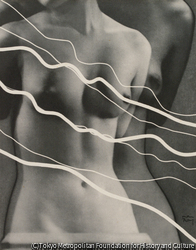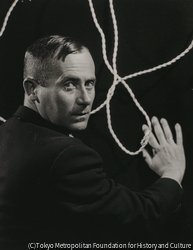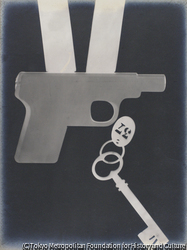
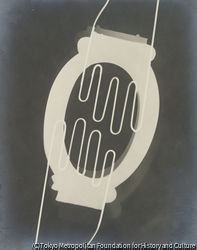
MAN RAY probably created his first photogram in the autumn of 1921. According to his own account, he discovered the techqniue by accident when he was developing photographs that had been commissioned by the fashion designer Paul Poiret.
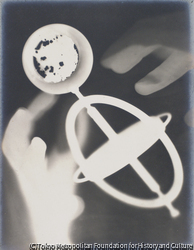
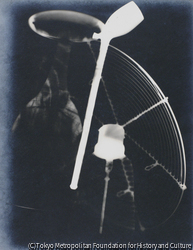
The photogram is created without a camera, by placing something directly on photo-sensitive material such as photograph printing paper and exposing it to light to create the image. Three-dimensional objects are rendered in silhouette, with unexpected changes in form, and, depending on the direction in which the light strikes, the initial form of the object may change in unexpected ways in the image. The “photogenic drawings” created in 1834, prior to the invention of the photographic process, by William Henry Scott Talbot might also be termed photograms. In the twentieth century, Dadaists such as Christian Schad and Surrealists adopted the photogram as a technique. MAN RAY regarded his method as the original and gave it the name Rayogram.
Research on the photogram was carried out at the Bauhaus in Germany, under the direction of Moholy-Nagy, who regarded it as the most nearly perfect method for reproducing the flow of light. The photogram was also used extensively in Japan, many by members of the Shinko Shashin (New Photography) movement from about 1930 on.
- Collection of
- Tokyo Photographic Art Museum
- Title
- (Hand-shaped wire and oval)
- Original title
- (Hand-shaped wire and oval)
- Artist Name
- MAN RAY
- Year
- 1926
- Material / Technique
- Gelatin silver print on developing-out paper
- Dimensions
- 352x276mm
- Accession number
- 20013053
- Tokyo Photographic Art Museum “Search the Collection”
- https://collection.topmuseum.jp/Publish/detailPage/29009/