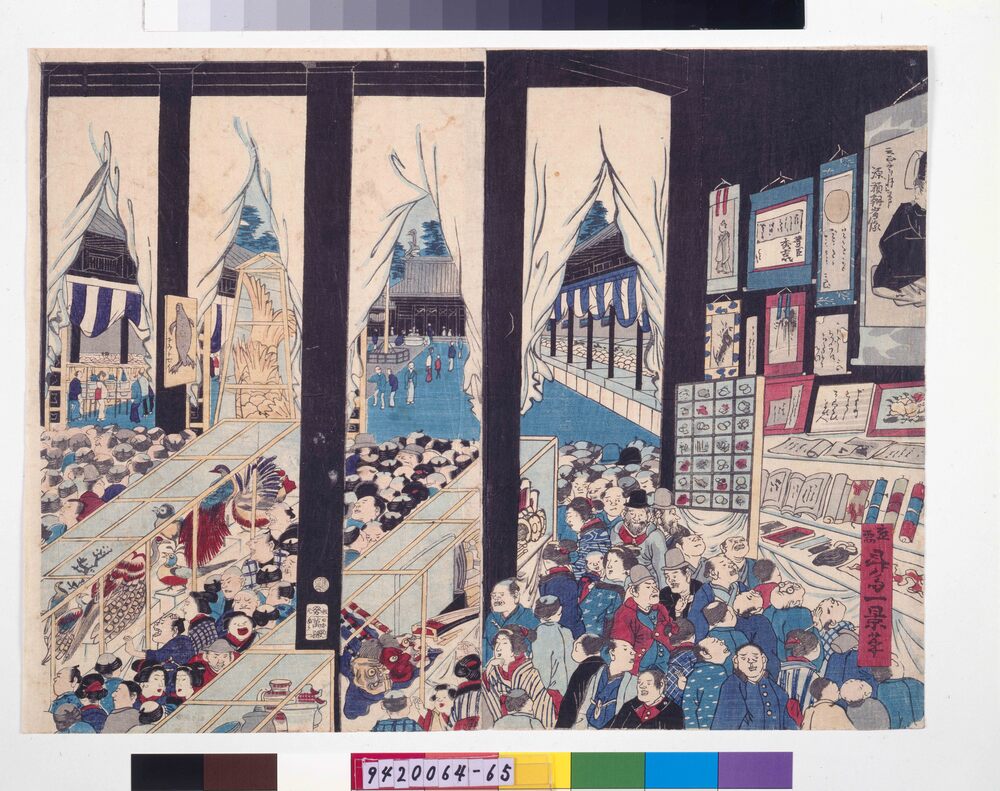
The Meiji government held the Yushima Seido Exposition, Tokyo’s first national exposition, from March 10 to April 30, 1872, in the Taiseiden Hall of the Yushima Seido, a former Confucian temple. In this print, we can see stuffed specimens of animals and other specimens in the glass display cases on the left. In the center are the kinshachi, the golden fish-shaped ornaments, from Nagoya Castle, one of the highlights of the exhibition. On the right are antique paintings, works of calligraphy, and other artworks, including works owned by the imperial family.
The purpose of this exposition was to display the items that would be exhibited the following year at the Vienna World’s Fair. While preparing those exhibitions, the new government was also making preparations for establishing a museum for collecting and conserving objects. The 1872 exposition, while oriented to new goals, domestically and internationally, also carried on many of the traditional characteristics of the bussan-e, product fairs displaying the natural products of each region, that had begun to be held in the Edo period.
This image depicts the exposition site almost overflowing with visitors. It might seem that the artist was exaggerating their numbers, but the exposition actually attracted about 3,000 visitors a day, far more than expected, and it was thus extended beyond the twenty days originally planned. Polychrome prints of the exposition, like this one, became souvenirs that communicated the excitement about the event throughout the country.
- Collection of
- Edo-Tokyo Museum
- Title
- Large Crowds Visiting the Exposition, Motoshoheizaka
- Collection ID
- 94200064-94200066
- Sub Category
- Block prints
- Creation Date
- 1872 19世紀
- Edo-Tokyo Museum Digital Archives
- https://www.edohakuarchives.jp/detail-9618.html