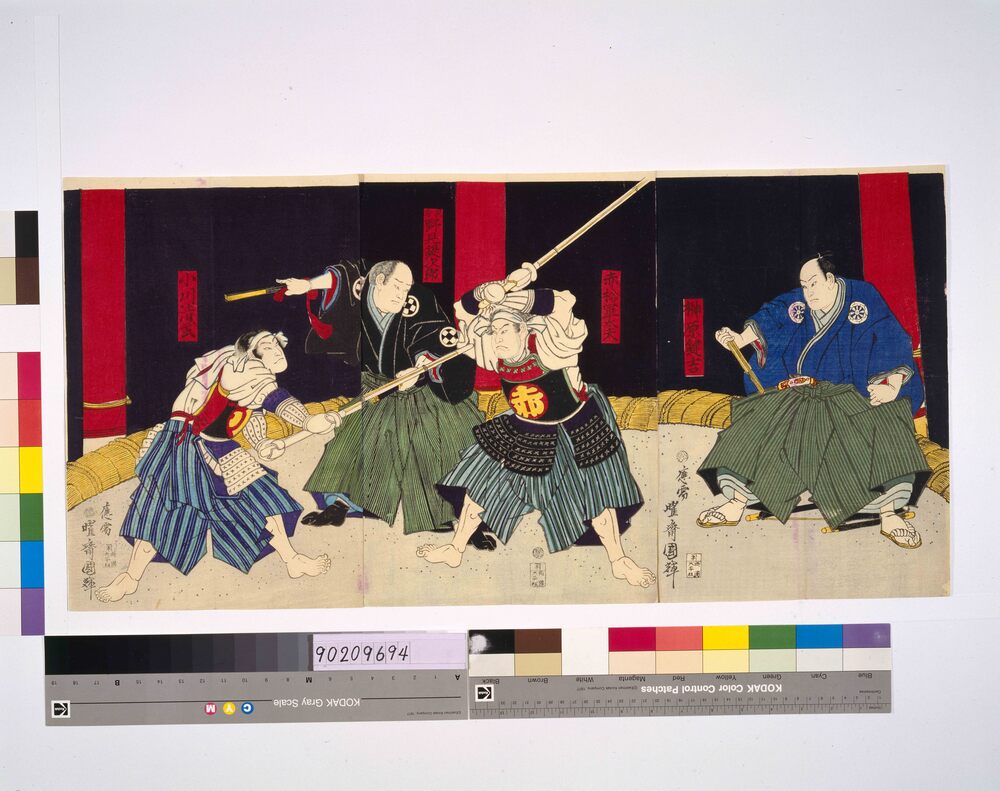
After the Restoration of imperial power in 1868, Japan adopted a Western-style military and prohibited carrying swords (carrying long swords had formerly been permitted only to members of the samurai class). These and other changes deprived master swordsmen, with skills honed in the Edo period, of their livelihoods. One such swordsman was Sakakibara Kenkichi, who had been an instructor at the shogunate’s military academy and a practitioner of the Jikishinkage-ryu style of fencing. Taking sumo wrestling as a model, he organized sword-fighting contests at which fellow swordsmen could demonstrate their expertise, offering them a way out of poverty.
This print depicts a sword-fighting show held, with the permission of the Tokyo prefectural government, in April 1873. The ring is defined by a circle of rice-straw bales, as in sumo, with red pillars surrounding them, a setting that clearly shows its origins in sumo.
In the center is Akamatsu Gundayu, brandishing his bamboo sword above his head. Facing him is Ogawa Kiyotake, his own bamboo sword at the ready. In between them, holding a fan, is the referee, Nomi Teijiro. On the right, seated on a folding stool, is Kenkichi, who had applied for permission to carry out this performance.
Thanks to the success of this event, which attracted a large audience, similar sword-fighting performances were also carried out within Tokyo prefecture. By July of that year, however, their vulgarization and associated scandals had led the Tokyo government to ban them. Through this print, we can glimpse men who had been warriors trying desperately to find a way to survive in a new age, the Meiji period.
- Collection of
- Edo-Tokyo Museum
- Collection ID
- 90209695-90209697
- Sub Category
- Creation Date
- 1873 19世紀
- Edo-Tokyo Museum Digital Archives
- https://www.edohakuarchives.jp/detail-5095.html